

Planned Tasting, Planned Calm
- Demetrovics Orsolya

- Feb 23
- 4 min read
We have already discussed emotion regulation, and here I would like to return to it while introducing a method called planned tasting. In recent parent groups and individual consultations, a common question arises: How can we stay calm when our child refuses to eat? Or refuses a food they previously liked? Or rejects a food outright that we had high hopes for? These are all situations that are difficult for parents, especially while trying to remain patient.
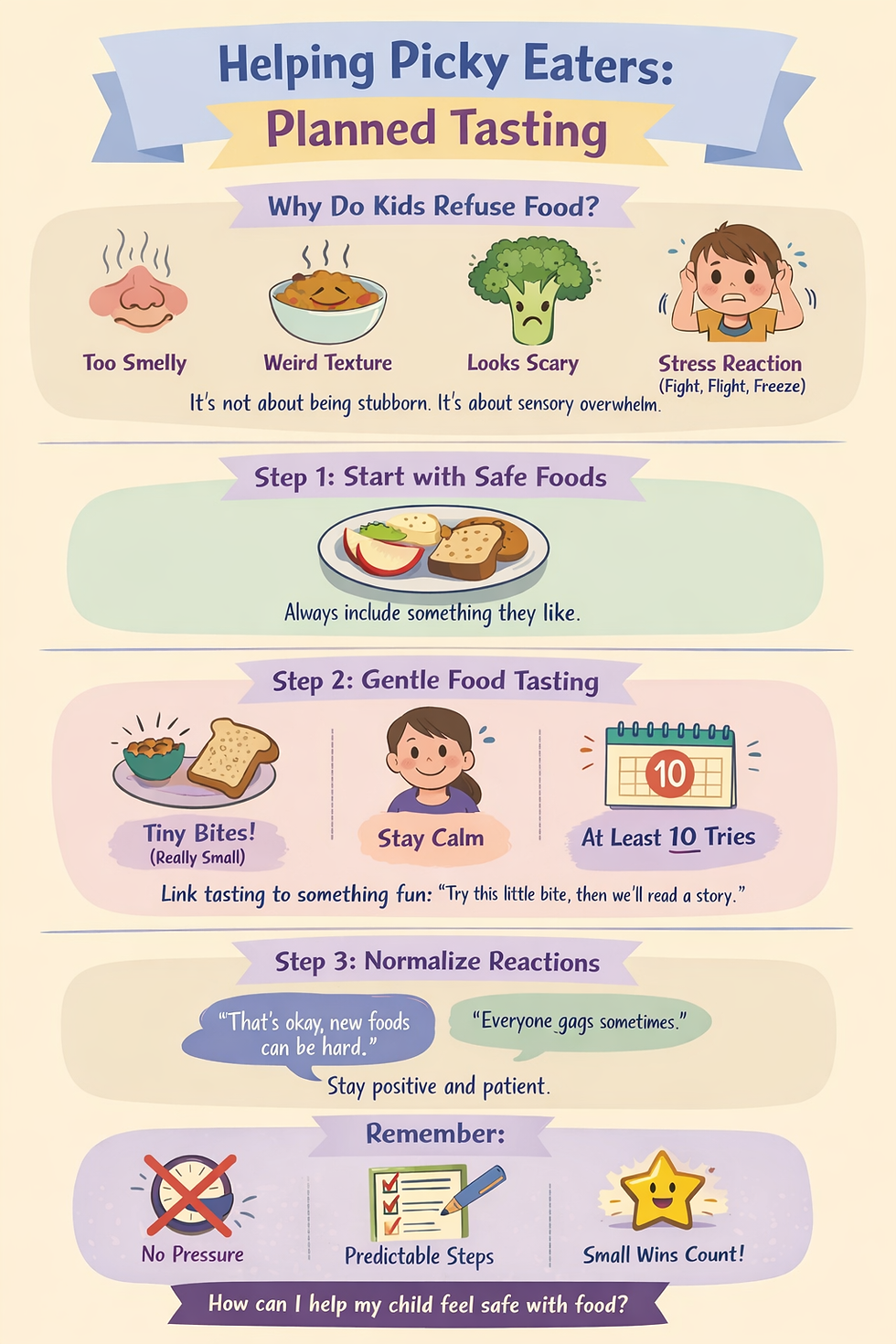
As mentioned before, eating is a highly stimulating activity. It involves numerous sensory inputs, and if our child is sensory-sensitive, these stimuli can feel overwhelming and uncontrollable. This can overload their nervous system and trigger a stress response: fight, flight, or freeze. Chronic stress can lead to rigid patterns around eating and, more broadly, affect the family’s eating habits.
Many of you say, and my own experience confirms, that a child’s selective eating over time can lead to restrictions in the family’s diet as well. Enthusiasm for trying new foods diminishes, hope for overcoming mealtime challenges fades, and the positive attitude that allows us to keep asking, “Will you taste this?” decreases. Often, cooking and grocery shopping feel less enjoyable, and family meals lose the joyful quality they once had. This is understandable, and I’m sure many of you recognize yourselves in this description. On top of this resignation, frustration, anxiety, and even anger may appear. We worry that our child is not eating, feel frustrated at being unable to solve the situation, or even angry that the child “won’t cooperate.” These are normal and understandable feelings.
However, with a child with ARFID (Avoidant/Restrictive Food Intake Disorder), eating cannot be measured by typical standards, nor compared even to the pickiest eaters. It is far more stressful and frustrating for the child and the family in everyday life. That is why it is crucial to have a clear plan for meals and long-term goals for what we are doing and why.
The first step is to accept that this is an illness, not a choice. If the child could, they wouldn’t behave this way—it is hard for them too. And we must recognise it is not our fault too.
For preschoolers, this is especially difficult. They are not motivated to change and are generally content as they are. They have safe foods, parental love, and are not facing long separations from home. At this age, neophobia peaks, making feeding more challenging than with older children. The first step remains the same as with older children: accept the situation and provide safe foods while offering as much exposure as possible to different foods in varied forms. Bake, cook, and eat together. The more exposure to new foods, the higher the likelihood the child will taste them later. Don’t pressure them—eat normally and wait until they show interest. Often, this interest naturally emerges, and if not, it simply means the child isn’t ready yet. Be patient.
Introduce new foods gradually, linking tasting to enjoyable activities. For example: “If you eat this small piece of X, we can continue reading the story” or continue a game. Let them spit out food if needed and have a preferred drink nearby. Consistency is key: don’t give up if they dislike it initially. At least 10 exposures are typically required for the child to develop a liking for a new food.
With school-aged children (8–10+ years), planned tasting can be introduced, where the child tastes very small amounts, stress-free, over at least 10 occasions. One taste is almost never enough for acceptance. New foods present entirely new sensory information that the child must learn to tolerate and process.
Start with foods similar to their safe foods to reduce sensory shock.
Alongside physical tolerance, mental desensitization is essential: children must learn that trying new foods is not frightening but a neutral or even pleasant experience. This gradually rebuilds trust in food and eating while giving the child a sense of confidence.
The process helps the child regain self-regulation, which is critical. Emotion regulation is a teachable skill developed through daily interactions.
For ARFID, introducing new foods should never be ad hoc. It is a long-term process requiring small, gradual steps and often professional guidance. The situation developed over months or years, so reversal will not be faster. Methods, such as the food-chaining, provide structured support in introducing new foods.
How to handle negative reactions to food:
If a sensory-sensitive child gags, grimaces, or says “yuck” or “smelly,” we need to tolerate these reactions. This is how they get used to new sensory input. Normalize gagging: “That’s okay, everyone gags sometimes” or “This is a new food, it’s normal that it’s hard for you.”
Parents must remain calm to help the child regulate emotions. Children often look to parents for guidance: “How am I supposed to eat this?” Remaining calm allows us to model self-regulation. If we cannot stay calm, we can step away briefly, ask a partner to take over, or “zoom out” mentally to regain composure. Sharing our strategies with the child is also helpful, teaching emotion regulation through modeling.
Young children rely on co-regulation, using the parent as help to manage emotions. Predictable situations reduce stress, which is why planned tasting works: children face challenging sensory input in a controlled, predictable way. Co-regulation is an interpersonal process where participants adjust interactions to create and maintain positive emotional states. It includes matching, conflict, repair, and dynamic interactions. Mistakes are part of the process, and repairing them strengthens the relationship.
A simple analogy: teaching a child to ride a bike. Initially, we hold the bike and help pedal. Gradually, the child balances on their own. Emotion regulation works similarly: children need support to regulate emotions before they can do it independently. Without co-regulation, maladaptive coping (e.g., emotional suppression) may develop.
In practical situations, respond with calm, normalized feedback. Even if the child spits out the food: “It’s okay, we’ll try again tomorrow.” This keeps the sensory system as calm as possible and helps restore emotional regulation quickly. Extreme reactions are normal; a new food is an extreme situation for a sensory-sensitive child. Through co-regulation, they learn to self-regulate over time.
Sources:


Comments